Zelensky resists ceding Donbas, after abandoning it years ago
Zelensky objects to ceding the Donbas region under Trump's peace plan. But when offered the chance to keep the region under a compromise with Russia, he adamantly refused.
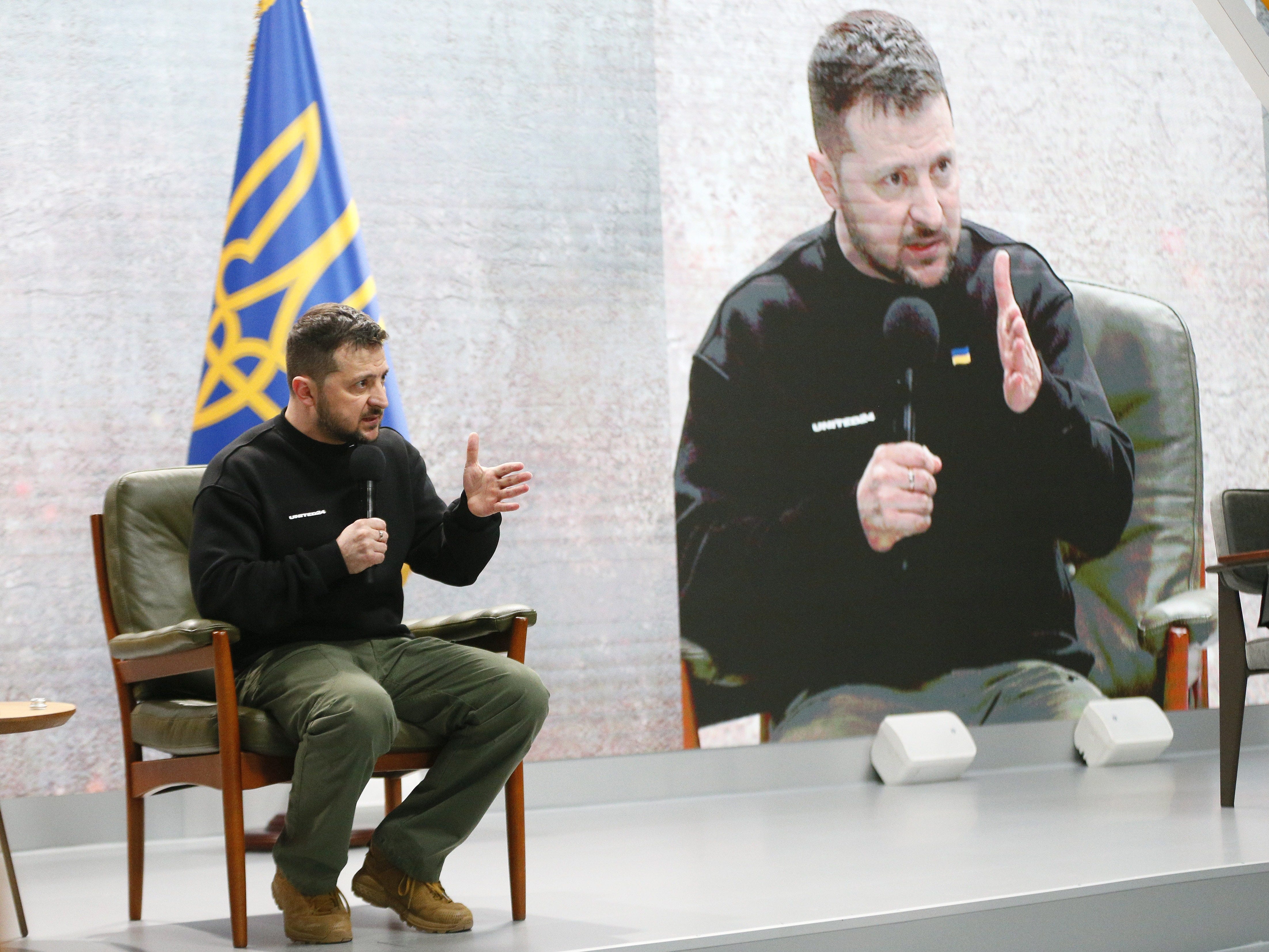
Since the Trump administration began pressuring him to reach a peace deal with Russia last month, Ukrainian president Volodymyr Zelensky has refused to cede any territory to Moscow. On Thursday, after a new round of salvos from President Trump, Zelensky appeared to leave some wiggle room. “The Russians want the whole of Donbas — we don’t accept that,” Zelensky told reporters. However, for the first time, he floated the idea of putting the issue to a national vote: “I believe that the Ukrainian people will answer this question. Whether in the form of elections or a referendum, the Ukrainian people must have a say.”
Any Ukrainian-administered referendum on the fate of the Donbas would exclude most of its population, who now live under Russian rule. While Zelensky insists that he will not reward what he sees as an illegal Russian land grab, the Ukrainian leader has squandered several opportunities to keep his borders intact. The February 2015 Minsk accords would have left the Donbas within Ukraine by granting it limited autonomy and abandoning Kyiv’s chances of joining NATO. Under the threat of ultra-nationalist violence, successive Ukrainian governments instead opted to retake Donbas by force and demonize the ethnic Russians who live there.
Back in 2016, Svoboda co-founder Andriy Parubiy, a post-coup cabinet member and parliamentary speaker who was assassinated in August of this year, scoffed at lawmakers who backed dialogue with the Donbas rebels. “Millions of Ukrainians were killed in eastern Ukraine by these same Muscovite occupiers from the Kremlin,” Parubiy said. “And today you appeal to the local population, to the opinion of the people who live there?” Vadym Prystaiko, Deputy Foreign Minister and later Zelensky’s ambassador to the UK, adopted a similar line. “It would be politically useless to talk to these people who are, in fact, field commanders and not Ukrainians in the full sense of the word,” Prystaiko declared. Minister of Internal Affairs Arsen Avakov echoed that view: “One cannot negotiate with the pro-Russian ‘Fifth Column,’ they understand only the language of force.”
In his successful 2019 campaign, Zelensky had promised a different course as “the president of peace.” But after coming into office and facing the traditional threat of far-right violence, his administration soon adopted their language. “This [Donbas] is a tumor we don’t know what to do with,” Oleksii Reznikov, then a top Ukrainian official and future Defense Minister under Zelensky, explained in November 2020. “We have two alternatives...you need to understand these territories are sick, including mentally. Option one is... amputation, option two is therapy. I’m in favor of therapy.”
Zelensky opted for amputation. “The people of the Donbas have been brainwashed,” Zelensky complained to Time Magazine’s Simon Shuster. “They live in the Russian information space... I can’t reach them. There is no hope of making those people understand that Russia is really an occupying power.” According to Shuster, who embedded with the Ukrainian president and his inner circle, Zelensky decided that “he had no chance of winning support in these regions.” For this reason, Zelensky ultimately abandoned the Minsk process and spoke of retaking the Donbas by force. “I have no intention of talking to terrorists, and it is just impossible for me in my position,” he explained in April 2021.
Zelensky’s uncompromising position endured in the lead-up to Russia’s invasion. “There have not been and will not be any direct negotiations with the separatists,” Andrii Yermak, recently ousted after years as Zelensky’s top aide, explained in January 2022. Added Ukrainian security chief Oleksiy Danilov: “The fulfillment of the Minsk agreement means the country’s destruction.” To underscore the point, Zelensky’s government escalated attacks on rebel-controlled areas in those fateful weeks.
The Russian attack forced Zelensky to abandon his hostility to negotiations, resulting in the Istanbul talks of March-April 2022. When Zelensky, under US-UK pressure, walked away from the deal that his own officials had brokered, that became yet another lost opportunity.
Hundreds of thousands of deaths later, a senior US official under Biden has finally come around to a belated acknowledgment that it all could have been avoided. In a discussion with two Russian pranksters posing as Ukrainian officials, Sloat recalled:
We had some conversations even before the war started about what if Ukraine comes out and just says to Russia, “Fine, we won’t go into NATO” if that stops the war—which at this point it may well have done. But I was uncomfortable with the idea of the U.S. pushing Ukraine not to do that and sort of implicitly giving Russia some sphere of influence or veto power on that.
You know, there is certainly a question almost three years on now: Would that have been better to do before the war started? Would that have been better to do in the Istanbul talks?
It certainly would have prevented the destruction and the loss of life.
Sloat’s casual admission that a simple declaration of Ukrainian neutrality – which the Biden administration strenuously opposed – “could have prevented the destruction and the loss of life” newly undermines the narrative that has sustained nearly four years of a catastrophic proxy war. It also underscores that Zelensky, having had to deal with US sponsors indifferent to participating in his country’s destruction, does not bear sole culpability. Yet having rejected a compromise with Russia and its Donbas allies back when he had the chance, the Ukrainian leader has little standing to complain about losing a region he abandoned years ago.